


Having just ushered two more daughters off to college and celebrated another son graduating, I’ve been reflecting often in recent weeks upon what it means to create a culture of human flourishing, as much in a school setting as in the home. The thoughts I share here come from multiple perspectives -- what I’ve seen as a father of now six high school graduates (four of whom have finished college) with another two still in the pipeline, what I’m reveling in as a grandfather with my son embarking upon his own journey as a parent (to a darling little girl!), what I’ve experienced during my 20 years leading Catholic schools, and what I’ve witnessed first-hand from my earlier professional days as a high school teacher and recent opportunities to be in the classroom with students at JSerra, the cherished place I have called home these last 14 years.
If I were to use a broad phrase to set the stage it would be, “the philosophy of work and the role of technology in relation to human dignity.” Or posed as a series of questions:
What habits of work should we strive to instill in young people so that they flourish in this world -- not just financially, but spiritually, socially, and emotionally?”
How has the proliferation of screens of all kinds and in all places helped and/or hindered young (and not so young!) men and women to become people fully alive?”
How do parents as the primary educators and we as schools create an environment for our young adults whereby they develop the ability to engage fully in deep work while also cultivating the habits of mind and virtue to develop and sustain meaningful, upbuilding relationships with peers and adults alike?”
Starting from the beginning, I think it’s important for us to keep in mind that we’re not raising children, so to say, but rather forming future adults. Seeing our kids not as teenagers but as wives and husbands or mothers and fathers in their 20s and 30s can help orient us in the decisions we make today in building our family culture. With my oldest approaching 30 and our youngest now 11, I have seen over time how my wife’s and my approach to parenting has shifted. I recall when our older ones became high schoolers, we were firm on the “no cell phone until you’re a senior” family policy. Then with the arrival of the next two in high school that shifted to “old-fashioned flip-phone when you get to JSerra.” And with the next two, it was “smartphone when you get to high school but only with filters in place and apps being monitored.”
This progression happened not necessarily because of our desire as parents to “adapt to the times.” Rather, it was a consequence of the actual challenges of having our children in an environment that required a smartphone as a tool for managing high school life. Taking pictures of homework to turn in on-line. Joining a group chat to find out the time of an event or practice. Logging a laptop onto the school network during the school day.
What we’ve also seen shift is how our children do work outside of the classroom. For our older children, I still recall the traditional scene of the textbook open on the kitchen counter alongside a notebook capturing the highlights from the lesson of the day in class. For our younger children, the more common scene has become a cell phone open next to a laptop — with PDFs downloaded from a teacher web-site up on a screen, a physical textbook replaced by an online textbook or no textbook at all, and required watching of videos to supplement (or replace) direct classroom instruction.
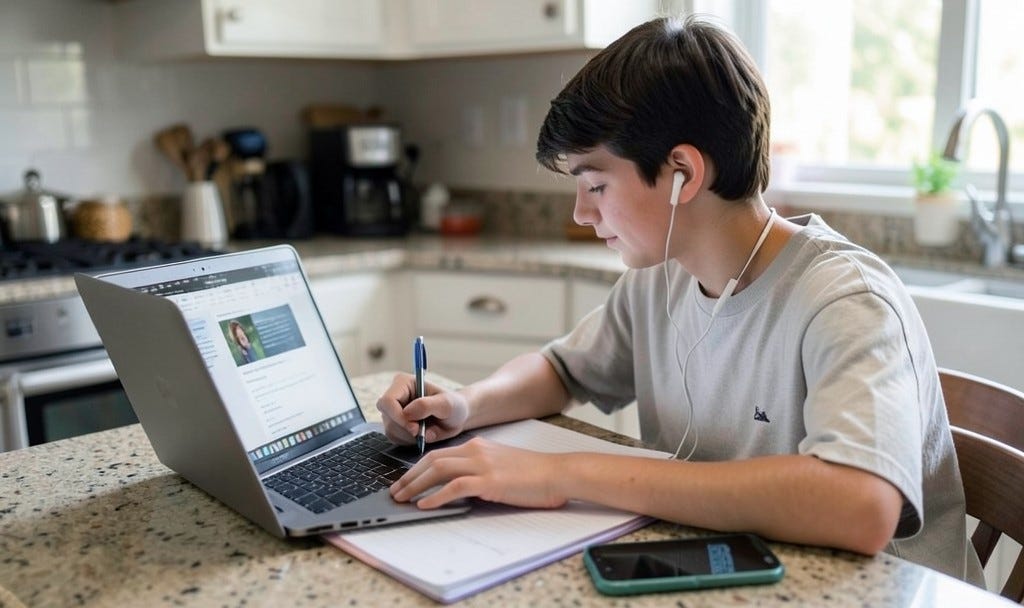
To be clear, I’m not suggesting there are not appropriate times for any of the above to be used by teachers for the benefit of students. As an example, some of the very best faculty at my school will “flip the classroom” and provide an online lecture so that more classroom time can be spent on experiential learning and answering specific questions from students. However, the picture I’m trying to paint is one in which our young people are being wired from a young age to be always wired. And I believe this has three significant downstream consequences that we as parents need to acknowledge.
First, over the past 25 years as both an educator and a father, I’ve seen the diminished ability of teenagers (and if I’m being honest, me too) to engage in deep work. By this I mean the skill to immerse oneself in a distraction-free environment in order to focus intently for a longer period of time on a single task at hand. Reading a novel. Completing a study guide. Writing a rough draft. Reviewing a chapter from the textbook. Summarizing ideas from handwritten class notes.
Second, these lost, or at least diminished, skills hinder the ability for teenagers to cultivate two critical virtues — temperance and industriousness. The former is the ability to control’s one’s passions and demonstrate self-restraint. The latter is represented by a person’s work ethic, diligence and persistence. In fact, renowned author, psychologist, and friend, Dr. Leonard Sax, often quotes a study citing self-control as the most important trait in young people that accurately predicts health and happiness twenty years later when they are adults.
Third, the way young people experience peer relationships is drifting dramatically away from the interpersonal. As just one data point, Jean Twenge in her book iGen cites a longitudinal study in which the amount of time teens spend with friends has dropped by more than 50% over the last 20 years while, not surprisingly, teenagers responding “yes” to the question “I feel lonely” has increased by this same percentage. This supports the modern societal paradox of being more connected than ever and, at the same time, more isolated than ever. Perhaps mature adults can handle the emotional implications of feeling alone, but for the developing teenager protracted periods of perceived or real marginalization can have significant long-term implications on their ability to thrive as adults.
With all of the above as a backdrop coupled with countless conversations I’ve had in recent years with parents and students alike, the question is, “So, what do we do about all of this?” Too often I have found myself responding that we just need to navigate this new paradigm — both as parents and as schools. Smartphones, laptops, the internet — these things certainly aren’t going away. So we best just learn how to function with them.
I’ve come to realize that my thinking has been deeply flawed.
What if there were a response that was far more aspirational and inspirational? What if parents, teachers, and students could blaze a trail? What if we worked together to create the roadmap for a generation of young people to cultivate the habits of mind and the human virtues that foster the ability to engage in deep work and be a joyful person, fully alive to love and serve others, all the while keeping the addictive powers of technology fully in check?
I’m not suggesting we haul out the abacus and ditch the calculators or bring back stone tablets in place of modern ones. Nor am I advocating for a lifestyle that is completely devoid of technology. But I do believe that a few hard and fast practices regarding school culture coupled with families’ freedom to implement changes in their own culture could have a radical, life-changing impact on the young people that have been entrusted to our care.
1. Cell-Phone Free Campus
Somewhere back around 2016 we established at my school a simple cell phone policy. Phones were not to be seen from the morning bell starting the day until the afternoon bell ending the day. And if you compared JSerra to other high schools, you likely would have agreed that we did a better job than many enforcing this rule. But, teenagers being teenagers, they quickly turned to texting furtively while in the halls or in the bathroom or simply were distracted because their phones, while not out and able to be seen, were on their person.
As evidence of what is often referred to as the “brain drain effect,” read the results of this 2017 study from the University of Texas. Spoiler alert — simply having phones in close physical proximity makes us perform worse on cognitive tasks. Adding further insult to injury, we tend not to realize or acknowledge this to be the case.
Have you ever forgotten your cell phone for a day at work? Perhaps for the first several minutes it was incredibly inconvenient. But shortly, if your experience has been anything like mine, you find yourself more productive and focused than ever. Imagine a world in which every day was like this for our students.
Ergo, our revised cell phone policy at the school became phones were not even allowed to be on a student’s person. They needed to be either in their lockers or, for our upperclassmen, in their cars. Almost immediately, the shift in the school culture was palpable. Now, I’m not so naive to think that there’s nary a device tucked away in a student’s pocket or backpack. But with this being the stated and strictly enforced policy, there is no situation in which a student should ever be accessing the device during the school day.
2. School-Issued Laptops
Almost since our school’s founding, we have always allowed students to bring their own laptops to campus — sacrificing institutional control for individual autonomy. Reflecting now on the classroom climate and our desire to maintain our students’ full engagement, we now provide them with a school-issued laptop. This enables us to be in a position to better form them in how to use this device as a professional productivity aid rather than a personalized distraction machine, thus building good study and work habits. Our young people are now immersed in a daily social-media-free haven as these sites are blocked — not at the network level but on the physical device itself. For the positive impact this has on the mental health of our teenagers (and most especially our young women), take a moment to read Jonathan Haidt’s 2021 article in The Atlantic.
3. Physical Books and Handwritten Notes
Admittedly, we haven’t reached a state of perfection as a school in this regard, but our long-term goal is for every student to have a physical textbook or learning resources for every class (or the classes for which this is most practical.) In addition, requiring students to take notes in class by hand rather than via a laptop serves to eliminate a large number of potential distractions for them. Apart from the the benefit gained by more focused attention, studies also show a significant increase in comprehension and retention when students take notes by hand versus using a laptop.
My school continues to be a work in progress. We certainly aren’t perfect. The strategies I’ve offered, in and of themselves, aren’t a magical elixir to the present challenges. However, what I find perhaps most encouraging is a growing willingness among students, faculty, and parents to engage in thoughtful discussions about what it takes for young people and adults alike to truly flourish in this world
In my next post, I’ll offer some personal insights related to challenges in this space on the home front — largely stemming from rounds of trial and error with my own children resulting in occasional wins, exasperating losses, and timely encouragement offered by my now adult children.
Until then, be Fully Alive!
Fantastic, Rich.